
Nova Scotia Intermediate Skills Challenge
Intermediate Skills Challenge
The Intermediate Skills Challenge (ISC) is a full-day, hands-on design challenge for Grade 8 & 9 students across the province! Working in teams of two, students design, build, and race model cars powered by renewable energy sources such as solar, wind, saltwater fuel cells, and more! Each team receives a base car kit in advance, along with funding to customize and adapt their design. This fun, fast-paced challenge brings science concepts to life while fostering creativity, problem-solving, and teamwork.
ISC Information Flyer
Teachers & Teams: Looking for more information about the Intermediate Skills Challenge? Click the button below to explore the details.
ISC Info FlyerModel Car Reimbursement Form
Teams: Did you purchase supplies for your model car customization? Click the button below to submit your reimbursement form.
ISC Model Car ReimbursementRegistration Questions
The Intermediate Skills Challenge is open to students in Grades 8 and 9 across Nova Scotia.
To ensure fair participation and representation from schools across the province, each school may register up to 5 teams (10 students total) for the Intermediate Skills Challenge.
Yes. Space is limited, and registration may close early if the event reaches capacity; however, students can be placed on the waitlist.
Once registration closes and the Green Energy Coordinator confirms your team’s spot in the challenge, a base model car kit will be sent to your school, along with a build guide and an information package containing everything you need to prepare for the challenge.
Competition, Build, and Green Energy Questions
Yes, because of the design of the racetrack, there will be size limitations on your car. The maximum dimensions after full assembly with all green energy components are as follows:
Width: Maximum of 5 inches. The base model car is 2.5 inches wide upon assembly.
Length: Maximum of 12 inches. The base model car is 7 inches long upon assembly.
Height: Maximum of 10 inches from the ground (including wheels). The base model car is 2 inches tall upon
assembly.
Don’t worry! Students are encouraged to troubleshoot and improve their designs throughout the build period. A maker space will also be available on event day for touch-ups, adjustments, and upgrades to help your car make it down the track!
Cars using a solar rechargeable battery are permitted, provided the battery is charged directly by the solar panel and all components meet the challenge requirements.
A standard battery powering a small wind turbine is not considered renewable energy. For wind-powered designs, the car must use the kinetic energy created by the wind, such as through a functional wind turbine or sail, to help power or propel the car.
Absolutely! This challenge is all about creativity and innovation. Want to build a solar-powered car with a sail to capture wind energy? Go for it! Maybe your team wants to build a 100% solar-powered car or experiment with a saltwater cell. Teams can use a single renewable energy source or combine multiple types; the possibilities are open, as long as the car is powered by renewable energy and meets the challenge requirements.
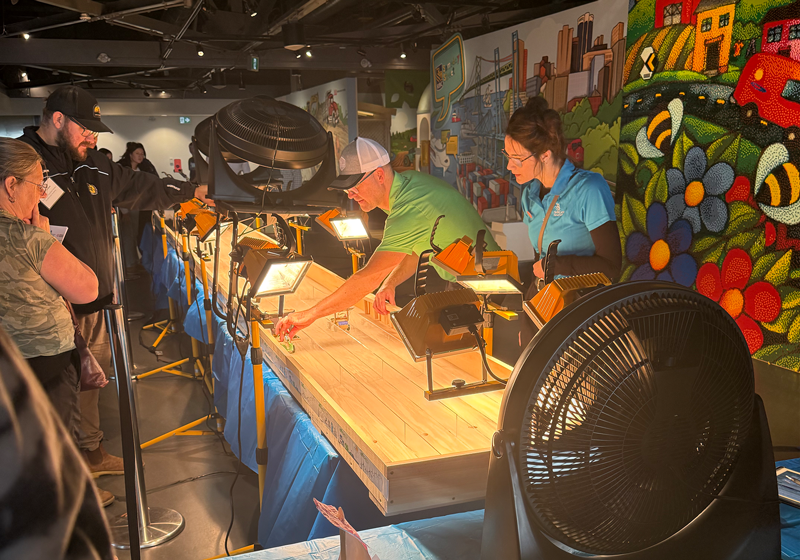
Halogen floodlights will be provided to simulate sunlight, and turbo fans will be used to simulate wind. Salt and water will also be provided. All teams will have access to the same energy sources. To protect the track and other vehicles, cars using water must be designed to prevent water from leaking or spilling onto the track.
Yes! Students are encouraged to be creative with the shape and design of their car. However, the axle placement must remain consistent with the original base model, as the race is considered complete when the front wheels cross the finish line.
Note: Please use caution when modifying the wooden block, particularly around the axle grooves, as damage can make it difficult for the car to run properly.
Teacher & Chaperone Questions
Yes. Schools are required to provide one chaperone for every 10 students attending the Intermediate Skills Challenge. Chaperones are responsible for supervising their students throughout the event.
Yes. SCNS will assist with substitute teacher coverage costs at a rate of $196.23 per day (amount identified by EECD) for teachers who bring registered students to compete in the Intermediate Skills Challenge.
Teachers are encouraged to guide, teach, and troubleshoot with students, but the design and build should ultimately be the students’ own work, showcasing their creativity, innovation, and problem-solving skills.
Morning snack, lunch, and beverages will be provided throughout the event day.